

Robot Parts Practice: Read Dependency Roles in a Manifest
2026-11-02
Robot Parts Practice: Read Dependency Roles in a Manifest
Dependency roles can help a reader understand what a package manifest declares about software associated with robot parts. They do not, on their own, show what is installed or whether hardware is compatible. This article proposes a read-only document exercise for an imaginary spare-controller information pack. No controller, package, or manifest was inspected. The learner first separates the roles in the declaration from observations that would need other evidence.
Identify the document before interpreting a dependency name
Start by asking which package the prepared teaching document describes. A dependency name has meaning within that context. The learner should not copy a familiar package name into a spare-part inventory merely because it appears somewhere in a source repository.
The Jazzy package tutorial identifies package.xml as package metadata. That description establishes a document role, not a finding about a particular controller delivery. The fictional exercise should keep those two levels separate.

Read the dependency tag as well as the named item
REP 149 specifies distinct dependency tags in the package manifest format. A learner should therefore read the surrounding role rather than reduce the document to an undifferentiated list of names.
For the imaginary pack, the instructor can ask which declarations concern building and which concern execution. The exercise should use the actual tag meaning explained in the prepared material. It should not infer the role from whether a dependency’s name sounds like a tool or a library.
The article supplies no real dependency list. If the instructor later prepares an authorized example, a learner should preserve the tag together with its named item. Removing the role would discard part of the information the lesson is intended to teach.
If prepared declarations name the same item in different roles, keep both role descriptions visible for discussion. The learner should explain each purpose before shortening the note, rather than discard the difference because the package name is repeated.
Keep a declaration separate from an installed arrangement
A manifest declaration says what the document describes in its stated context. It is not an observation of the software currently present on an arbitrary controller. A practical note should not move directly from reading a tag to claiming the corresponding item is installed.
In the fictional class, put declaration reading and installation observation in different explanation spaces. The second space may remain empty if the lesson does not include an authorized installation review. That gap is preferable to filling it from expectations about the first.
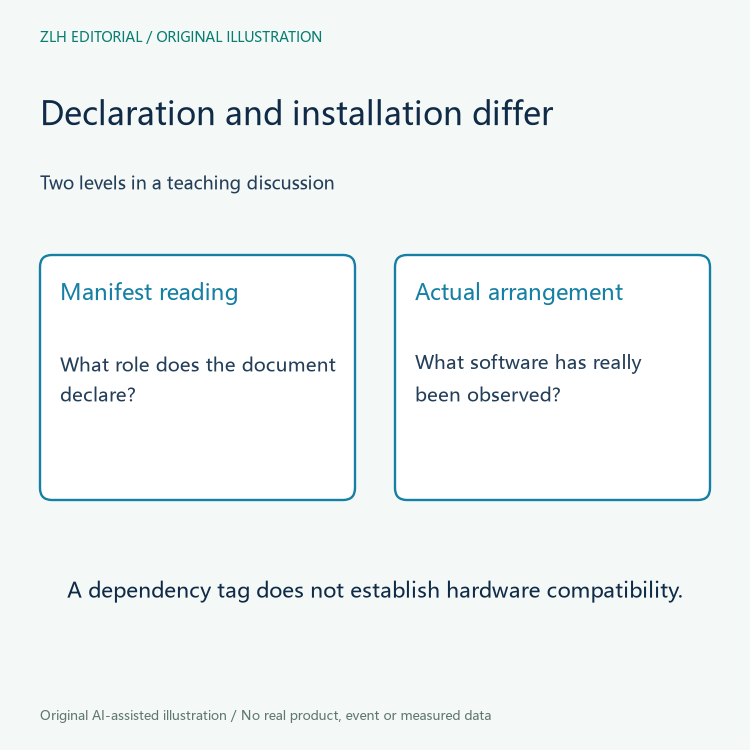
This exercise does not run a dependency resolver, change a package environment, or connect to hardware. Its limited purpose is to improve the reading of software documents supplied for discussion.
Do not turn a software role into a hardware conclusion
A spare-controller information pack may include several kinds of material. Understanding one package’s dependency declarations would not establish the physical suitability of the controller, the completeness of the delivery, or the behavior of the assembled system. Those claims concern further information.
For the imaginary lesson, a learner can formulate a focused provider question: which supplied software does this document describe? The provider’s actual answer would need to establish the relationship. The article cannot create that relationship simply by presenting the manifest terminology clearly.
If the supplied teaching context is incomplete, retain the uncertainty. Do not label a part compatible or incompatible solely because one dependency name appears or is absent from a document whose scope is not yet understood.
Use ambiguous entries as reading questions
When a learner cannot explain a declaration’s role, return to the relevant format guidance and the document context. A general guess about a name is not a substitute. The instructor should clarify the intended learning material before the class extends the interpretation.
The same discipline applies to abbreviated notes. A short handover description should preserve enough information to distinguish a build-related declaration from an execution-related one. It should not shorten both into a generic present-or-missing claim.
Ask another reader to reconstruct the declaration
At the end, a colleague should be able to identify the described package, the named dependency, and the role supplied by its tag. If the summary omits one of these, revise it. A reader should not have to reconstruct the role from a guessed installation story.
A useful exercise result is a precise document explanation with visible limits. It is not a completed installation, a verified inventory, or a spare-part assessment. Those activities remain separate and require their own actual scope.
More discussion appears in our robot-parts evidence section and the reading directory. The two original diagrams contain no real package list, controller configuration, installation output, or hardware test result.


