

Robot Parts Diagram Acceptance: Review the SVG Scaling
2026-11-02
Robot Parts Diagram Acceptance: Review the SVG Scaling
SVG scaling affects how a supplier’s robot-parts diagram appears in a receiving portal or document. A shape that looks compressed may reflect the display arrangement rather than the physical part it depicts. Before accepting the illustration as an enquiry attachment, the buyer should ask how the drawing’s coordinates map into the displayed region. This article proposes that review and measures no actual component or supplier image.
State what the diagram is intended to communicate
Ask whether the supplier provides an explanatory illustration, a dimensioned drawing, or another explicitly defined deliverable. These roles require different evidence. A diagram used to locate a connector should not silently become proof of fit or a source of measured dimensions.
The receiving team should identify the actual source file and the display context under review. A screenshot embedded in an enquiry is different from the editable vector source. If the portal changes the display, the acceptance note should preserve the relationship rather than treat both appearances as interchangeable. Ask the recipient to retain the attachment’s stated role beside the image, so later readers do not mistake an enquiry illustration for an approved engineering drawing.
For the fictional handover, no drawing or part dimensions are supplied. The buyer can still ask which display behavior is intended. Inventing a realistic connector outline would risk suggesting a physical specification that the proposed checklist does not establish.

Separate the viewBox from the display viewport
The SVG 2 coordinate systems specification describes the mapping from a viewBox rectangle in user coordinates to the viewport region. That relationship helps explain why internal drawing coordinates and the area reserved for display are distinct parts of the representation.
Ask the supplier to identify the relevant coordinate and display context for the delivered illustration. A number in a viewBox is not automatically a measured dimension of a robot part. The buyer should not infer a physical scale without the appropriate drawing information and agreed interpretation.
A resized browser window or document frame can change how the diagram is presented. A review should identify the specific presentation it examined rather than describe every possible display as verified. The source geometry and its rendered appearance need related but separate records.
Ask what aspect-ratio behavior is intended
MDN’s preserveAspectRatio reference explains alignment and the meet or slice behavior used when the viewBox and viewport proportions differ. It also explains that none does not force uniform scaling. The supplier should say which behavior is intended for the actual illustration.
This gives the buyer a concrete question when a displayed shape looks stretched or partly outside the visible area. Do not immediately conclude that the depicted part has changed. First identify the source and rendering context. A visual difference is an observation whose cause needs examination.
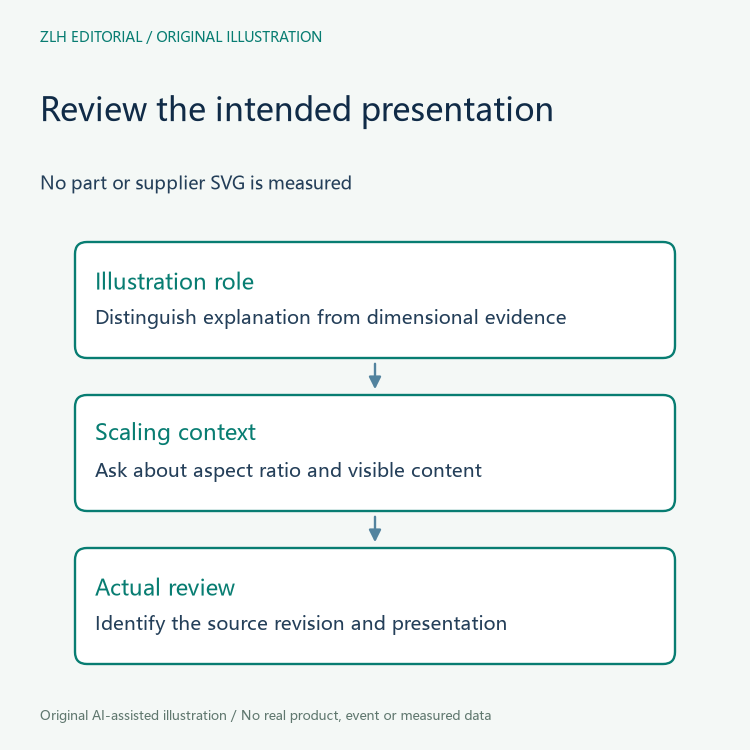
No actual rendering comparison is performed here. The documentation explains possible behavior, not the cause of a real supplier’s display issue. A later authorized review should preserve the actual input and presentation before assigning the difference to a particular setting.
Review annotations along with the visible outline
A parts enquiry often relies on labels, arrows, or a marked location as much as on the outer shape. Ask whether those annotations remain readable and associated with the intended feature in the delivered presentation. A complete-looking outline does not establish that the explanatory content survived.
If the supplier revises the illustration to improve presentation, retain the earlier file and identify the change. Do not overwrite the source and then report that the original was accepted. The receiving reviewer needs to know which revision the observation concerns.
Keep dimensional and compatibility questions outside a mere image-display check. A readable diagram can help a supplier understand an enquiry without establishing the correct replacement part, material, electrical interface, or mechanical fit. Those matters need their own evidence from the responsible parties.
Close the illustration task with a clear boundary
The proposed acceptance note should identify the illustration’s role, source revision, coordinate context, intended scaling behavior, and actual presentation reviewed. Any uncertainty about missing content or distorted appearance should remain an open question for the supplier.
Ask who will confirm the intended rendering when the image moves between systems. The author of the vector file and the owner of the receiving portal may hold different parts of the explanation. Keeping those responsibilities visible helps prevent an unexplained display change from becoming a false part specification.
More enquiry methods appear in our robot parts section and the article directory. The original illustrations contain no real part drawing, dimensions, measured distortion, supplier product, or completed compatibility assessment.


