

Fast DDS 3.6.2 Notes: Read the ABI Change in Context
2026-11-03
Fast DDS 3.6.2 Notes: Read the ABI Change in Context
An ABI change mentioned in a communication-library release deserves its own context before appearing in a robot-parts enquiry. The official Fast DDS 3.6.2 entry, published on July 2, 2026, includes an item about reverting an ABI extension. A reader should identify what the project describes rather than infer that an unspecified replacement controller has been examined. This source review installs no library, changes no firmware, and tests no equipment.
Locate the specific entry within the dated release
The official 3.6.2 release notes list the ABI-related reversion among other fixes. The surrounding release contains different categories of change. A parts publication should not combine them into a general claim that every concern about a supplier’s communication software has been resolved.
Retain the version and publication date when recording the item. This article revisits that cited release; it does not announce a new controller update today. A reader’s actual installed package and supplier support arrangement remain unknown until the responsible owner identifies them.
Before discussing a replacement part, name the software relationship being asked about. The presence of a familiar library name in a document does not identify the complete delivered configuration. A focused question is more useful than an unqualified compatible label.

Read the linked change description at its stated boundary
The project’s pull request 6420 explains that it reverses an earlier ABI extension associated with a statistics DomainParticipant issue. Its description discusses the project’s handling of the relevant sanitizer-test context. That is a specific development explanation, not a record of tests on a reader’s controller.
The editorial summary should preserve the affected project context rather than expand the change into a universal assurance about every application using the library. A development item can be relevant without answering all questions about packaging, integration, or supplier responsibility.
No code is compiled or inspected as a local delivery here. The linked project record supplies background for the question. A separate supplier statement would need to identify the actual software it describes and the evidence supporting that statement.
Keep the library version beside the delivered configuration
A parts enquiry should distinguish a library release from the package supplied with the component. Ask the supplier which artifact, build context, and documented dependencies its explanation concerns. An upstream version name alone is not a complete inventory of the controller software.
The receiver should also ask whether the supplied material is a current configuration record or a general product brochure. These documents can serve different purposes. A broad feature list should not silently become evidence that a particular unit contains a particular build.
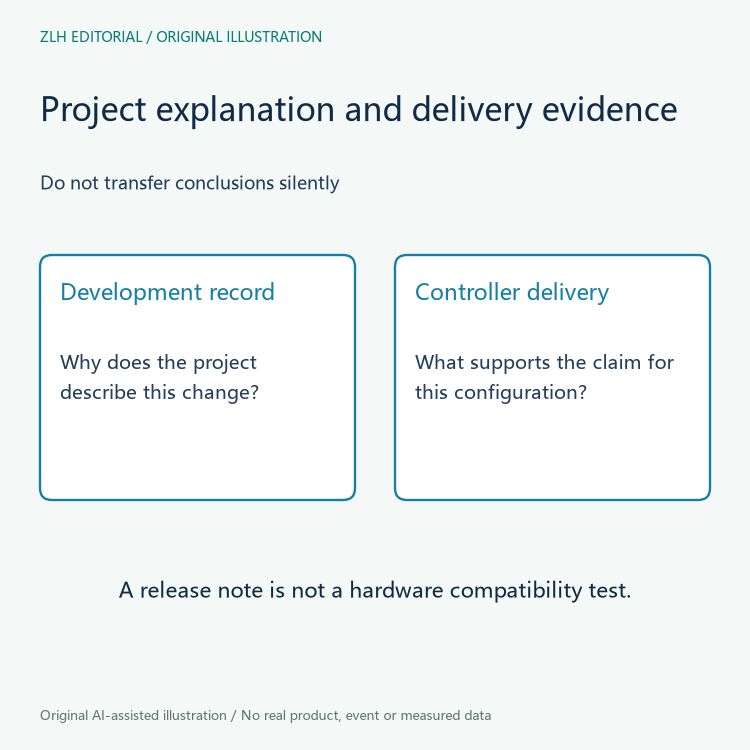
For a proposed review, leave the unit and artifact unidentified until actual material is available. Inventing a controller model or a test log would add an appearance of certainty without the evidence the enquiry needs.
Separate a project fix from a completed integration review
The project record can explain why a change was made. It does not show which integration checks a supplier performed for a delivery. Ask which observations actually support the supplier’s claim and keep those observations attached to their configuration.
If the buyer needs a comparison with earlier software, identify the earlier object explicitly. A familiar filename or an unchanged marketing label may conceal a different package. The relevant relationship should be explained rather than reconstructed from a screenshot or a brief release headline.
A later authorized review should preserve unexpected results as well as expected ones. It should not describe an unperformed integration exercise as successful simply because the upstream project lists a fix. This article reports no such exercise.
Avoid turning release interpretation into a hardware instruction
Reading the notes is not permission to modify equipment. Update authority, recovery arrangements, support scope, and physical operations belong to the responsible parties and their actual context. The present article proposes no change to a production controller.
Likewise, an ABI-related statement should not become a claim about mechanical fit, electrical suitability, or the condition of a spare part. Those are different questions. A clear technical enquiry keeps each claim beside the evidence that can address it.
Keep the parts question attributable
A useful publication connects the dated upstream item, the linked development explanation, and the unresolved question about the supplied configuration. It can acknowledge relevant software work without pretending that a physical component has been accepted.
Ask who owns the remaining configuration question and what material is needed next. A precise open item helps a supplier respond. It is more informative than a broad reassurance detached from the controller and software actually under consideration.
More notes appear in our robot parts software section and the reading directory. The original illustrations contain no real controller, installed binary, sanitizer output, compatibility result, or completed repair.


