

Robot-Parts Software: Distribution and Import Names
2026-11-04
Robot-Parts Software: Distribution and Import Names
Three Questions Behind a Package Note
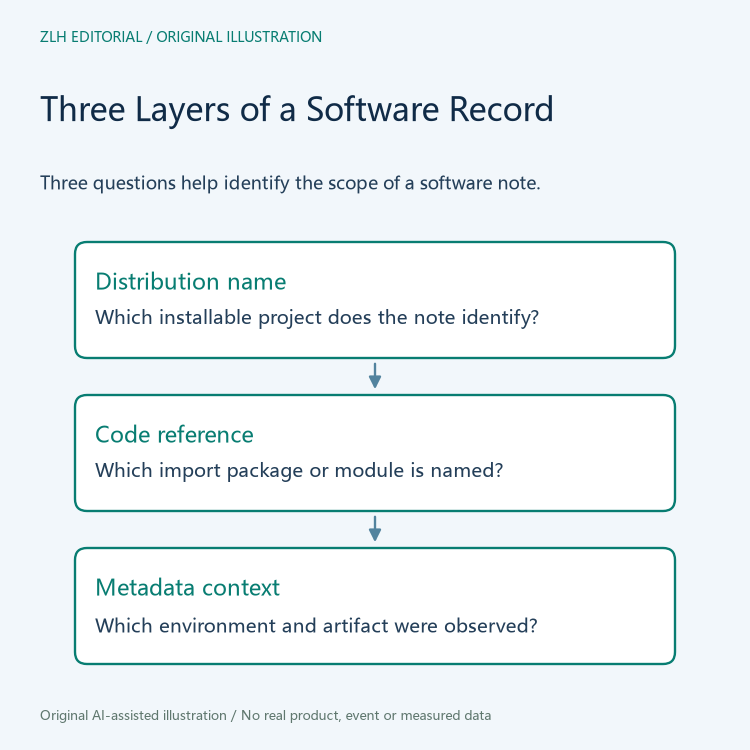
A robot-parts software note may identify an installable project, a name used in code and an observation about distribution metadata. Those are three questions, rather than three interchangeable package names. This article proposes a documentation reading method using a fictional driver note. It performs no installation, import, metadata lookup or controller operation, and it makes no claim that a few record fields completely describe a software environment.
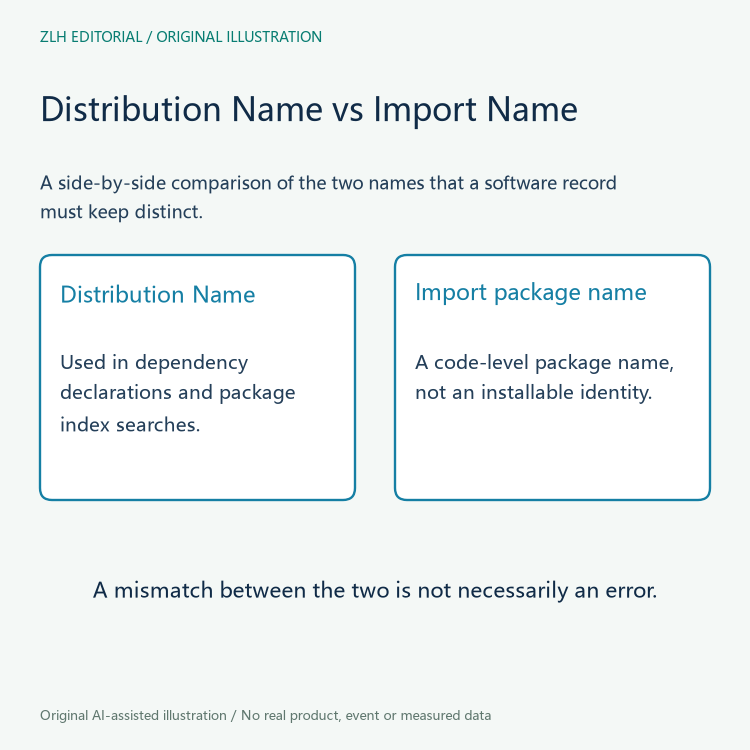
The Python Packaging User Guide distinguishes an installable distribution package from an import package, a special kind of module that can contain submodules. The names need not match. Its Pillow/PIL example illustrates the distinction; it does not establish the naming of a hypothetical robot driver. Preserve the role of a name before deciding what it identifies.
What a Distribution Package Name Actually Identifies
A distribution name can identify the project discussed in a dependency declaration or a package-index entry. Record the spelling and the source of the declaration so another reader can locate the same statement. This article does not prescribe a name-normalization implementation. A familiar-looking name alone is not evidence of the package source, version or compatibility with equipment.
It is important not to treat the distribution name as a guarantee about what the code will import. The packaging guide is clear that package indices do not enforce any relationship between a distribution name and the import packages it provides. A distribution called robot-vision-tools might provide an import package called vision, or it might provide several. The distribution name tells you what to install; it does not tell you what to type in an import statement.
What an Import Package Name Actually Identifies
A code reference may name an import package or a non-package module. An import package can contain submodules, so the terms should not be collapsed indiscriminately. In a fictional driver note, a name such as gripctl should be kept with its code context. Its spelling does not, by itself, identify which distribution supplies it.
The receiving editor can keep the code reference separate from the installable-project name. If the relationship is unclear, ask the contributor to identify the supplied artifact and the applicable documentation. An installation description is not an observation that a particular import succeeded. No such test is performed here.
Installed Metadata Is a Third Layer
The importlib.metadata documentation describes distribution metadata discovery and the packages_distributions mapping. The relationship need not be one-to-one: a distribution may supply several import packages, while a namespace package may relate to multiple distributions. Keep the context and limits of a discovered mapping with the record rather than assuming a universal pairing.
If a metadata observation is supplied, identify the environment and artifact to which it refers. Metadata discovery can involve filesystem locations, archives and extension mechanisms. The result should not silently be attributed to a different controller, interpreter or delivery. Some arrangements may not provide a complete top-level-name mapping, so an absent entry also needs interpretation within its actual context.
A Hypothetical Driver-Documentation Reading
Consider a fictional robot gripper controller. The driver documentation for the controller states that a companion library called grip-driver is required, and that the controller's Python interface is available from a module called gripctl. A technician reads this note and creates a software record with three fields: the distribution name grip-driver, the import package name gripctl, and a metadata lookup entry that records the installed version of grip-driver in the controller's runtime environment.
A second fictional reviewer could ask whether the supplied metadata observation refers to the spare unit or to a separate development environment. It could also ask what supports the relationship between grip-driver and gripctl. Matching a version label would be one observation, not proof of a working import, compatible driver behavior or complete environment reconstruction. The hypothetical review executes no software.
The scenario illustrates why an unfamiliar code name should not automatically be substituted into an installation request. The relationship needs the contributor's relevant documentation or artifact evidence. This fictional example identifies no actual package source or robot product, and it supplies no installation instruction.
Practical Record-Keeping Without Compatibility Claims
The proposed fields help a reader ask which artifact, code reference and metadata context a note describes. They do not completely reconstruct an environment or establish compatibility. Keep any documented dependency requirement separate from what was actually observed, and leave missing environment evidence unresolved.
A supplied version string can help answer a version-specific question, but it is not always the only relevant metadata. Ask which observation the receiving team needs and which context produced it. Entry point metadata, if relevant, describes another aspect of a distribution; it should not be turned into proof that a command wrapper or plugin was executed successfully.
Preserving the original spelling alongside its source is an editorial suggestion. If another tool normalizes a name, keep that transformation distinguishable rather than attributing the normalized text to the contributor. This article does not test a resolver or define a substitute for the relevant packaging specifications.
Keeping the Record Useful Over Time
A robot-parts software record is not a one-time artifact. It is a living document that should be updated when the software environment changes. If a new version of the distribution is installed, the metadata lookup field should be updated. If the import package name changes — for example, if a fork renames its module — the import package field should be updated, and the old name should be preserved in a note so that a later reader can understand why the record changed.
The packaging guide's example of the Pillow distribution and its PIL import package is a useful reminder that name mismatches are not always errors. They can be the result of historical decisions, forks, or deliberate design choices. A robot-parts software record that treats a name mismatch as a defect will generate false alarms; a record that treats it as information will help a later reader understand the software stack more clearly.
When a record is handed over to another team, the three fields should be presented together, with a note explaining which layer each field describes. This is especially important in a robot-parts context, where the software may be installed on a controller that is not directly accessible to the person reading the record. A clear separation of distribution name, import name, and metadata lookup allows the reader to plan their verification steps without needing to reverse-engineer the record's intent.
Primary reference for the document terminology discussed here: https://packaging.python.org/en/latest/discussions/distribution-package-vs-import-package/.
Primary reference for the document terminology discussed here: https://docs.python.org/3/library/importlib.metadata.html.
Related reading: robot parts documentation articles and article directory.


