

Robot Parts Records: Read Each URDF Origin in Context
2026-11-04
Robot Parts Records: Read Each URDF Origin in Context
A robot-parts record may include several URDF origin entries, each containing familiar coordinate names. Copying those entries into a single column can remove the context needed to interpret them. The useful reading question is not simply what numbers appear, but where each entry belongs in the model description. This article uses a published urdfdom schema and ROS coordinate conventions to organize a static documentation review. It does not load a model, calculate a transform or assess whether a replacement part fits a robot.
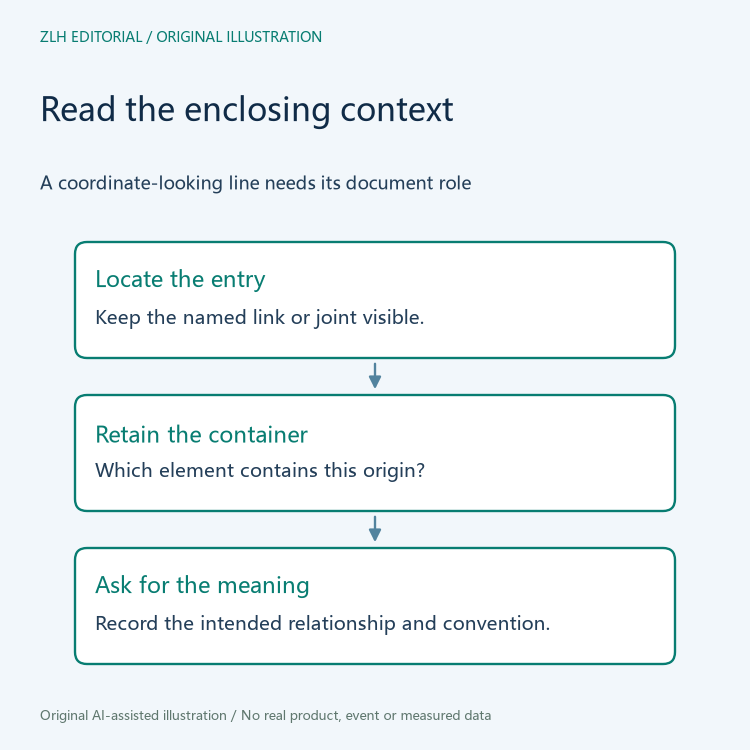
Preserve the enclosing element with the origin entry
Before interpreting a coordinate tuple, record the path of the entry within the document. An origin under a visual element and an origin under a joint do not occupy the same structural position merely because they use the same tag name. A parts enquiry should retain the enclosing element and the relevant named link or joint, rather than sending an isolated line stripped from the file.
Consider a hypothetical supplier note that says the origin has changed. The attached model contains more than one origin entry, so the statement leaves the recipient unable to identify the intended change. Asking for the enclosing path and the before-and-after source passage resolves a documentation ambiguity. It does not authorize changing coordinates or demonstrate that any installed machine has an incorrect reference frame.
Read the published schema with its stated status
The urdfdom project's published URDF schema file calls itself a proposal XML schema in its header. That qualification must travel with an explanation based on it. The source is useful for inspecting declared structure, but the heading is not a warrant to describe the file as a complete, universally enforced specification for every URDF consumer.
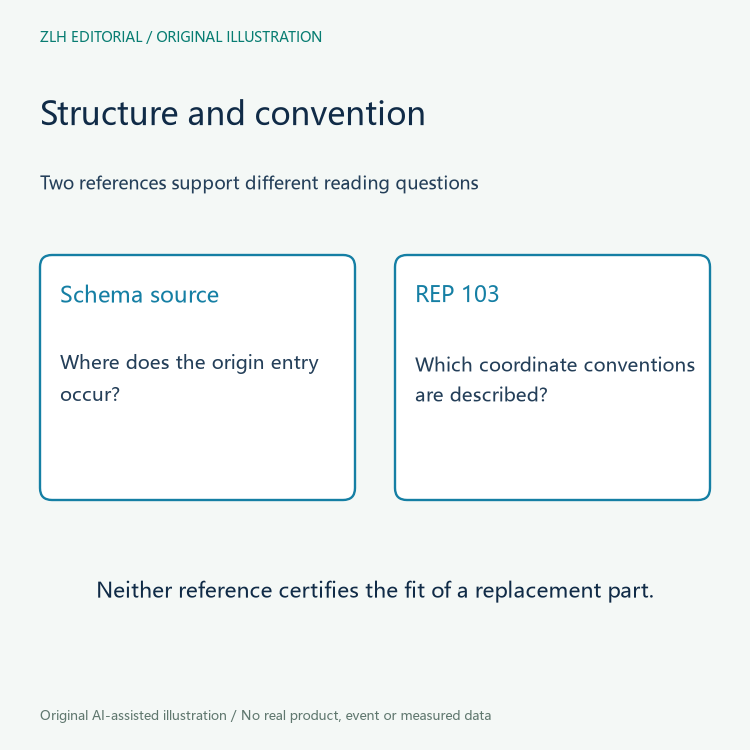
Within that source, a pose type declares xyz and rpy attributes. The same pose type is referenced by origin elements in several enclosing structures, including visual, collision, inertial and joint definitions. The narrow reading supported here is that repeated coordinate-looking entries have identifiable structural contexts. It does not follow that every application handles every extension or optional value in exactly the same way.
A reviewer should therefore distinguish the source being read from the parser that might later consume a delivered model. The repository's master branch is also a changing reference, not an immutable record. Preserve a snapshot or revision when the exact declaration matters to a supplier response. The source captured for an enquiry and the model delivered with the proposed part should remain separately identifiable.
Attach the coordinate convention to the explanation
ROS REP 103 is an informational reference for standard units and coordinate conventions. It specifies SI-based conventions, right-handed systems and a standard body-axis orientation, and discusses rotation representations. It also acknowledges that the scope of robotics software is too broad to require every program to follow its guidance, asking that different conventions be justified and documented.
Those qualifications make the convention a reading aid rather than proof about an unknown delivery. An enquiry can ask which convention the contributor intended, where it is documented and whether an exception applies. Familiar labels such as roll, pitch and yaw do not make an unexplained tuple self-contained. The description still needs its representation, units and the relationship under discussion.
Do not estimate a missing convention from the apparent position of a part in a rendered image. A view can communicate the author's intended appearance while leaving the underlying coordinate explanation incomplete. Ask for the missing documentation and retain the uncertainty in the parts record. No numerical example is needed to make that request, and inventing one could make an unverified assumption look like a supplied specification.
Separate a source comparison from a behavior claim
A static comparison can establish that a particular source passage differs between two identified model revisions. It cannot by itself establish which file was used by a running application, how that application interpreted the entry, or whether a physical assembly was changed. Keep each of those questions separate when preparing a replacement-parts enquiry. The documentation is one input to the review, not its completed operational result.
For the fictional supplier note, a bounded response might identify the changed enclosing entry and request the intended relationship in words. If a recipient later needs a software demonstration, that should be defined with its own environment and expected observation. This article supplies no execution sequence and makes no recommendation to alter a connected robot. The present task ends with a clearer description of the model source.
Make the parts handover readable without the screenshot
A good handover includes the source model identity, enclosing entry, stated convention and contributor explanation. It distinguishes an unanswered question from a confirmed change and names the evidence supporting any conclusion. If a revised model arrives, retain the original question beside the response so that a later reviewer can see whether the same entry was addressed. A new file name alone does not explain the revision.
The original diagrams show document relationships without fabricating a part, coordinate value or measured fit result. Further discussion in the robot parts evidence collection and the article directory covers related handover topics. Keeping the URDF origin attached to its enclosing structure makes a model note interpretable while leaving implementation, dimensional verification and physical acceptance to their own evidence.


